
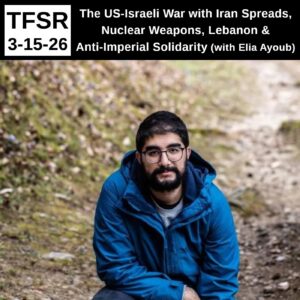
This week, we’re sharing our interview with Elia Ayoub, an anti-authoritarian historian and essayist originally from Lebanon, co-founder of From The Periphery media collective, co-host of The Fire These Times podcast and many more things. We spoke about the US and Israeli war on Iran, it’s escalations into the wider region of west Asia, the Axis of Resistance, nuclear weapons, motivations of the various actors involved and thoughts on where that leaves anti-authoritarians in the imperial core countries like the US.
Elia links
- You can contact Elia by email at ayoub@thefirethesetimes.com or on Signal at @ ayoub.02
- Elia’s blog ( https://www.hauntologies.net/ ) and Ko-Fi account ( https://ko-fi.com/eliaayoub )
- Elia’s Lebanon class: https://thefirethesetimes.com/lebanonclass/
- Where you’ll soon find Elias latest +972 article: https://www.972mag.com/writer/elia-ayoub/
- From The Periphery Patreon: https://www.patreon.com/fromtheperiphery
- FTP website: https://fromtheperiphery.com/
- The Fire These Times Podcast: https://firenexttime.net/why-neutral-anti-imperialism-keeps-losing/
Related Episodes:
- Our recent interview about Iran before the war: https://thefinalstrawradio.noblogs.org/post/2026/02/15/death-to-the-dictator-uprising-and-repression-in-iran-with-anarchism-perspective/
- Past interviews we’ve done with Elia: https://thefinalstrawradio.noblogs.org/post/category/elia-j-ayoub/
Mutual Aid in Lebanon
- Instagrams featuring info on some mutual aid efforts in Lebanon:
- Lebanon Emergency Relief: https://www.chuffed.org/project/171933-lebanon-emergency-relief
- A Queer Lebanese mutual aid project involving Elia’s co-creator, Ayman Makruem: https://www.patreon.com/qmalebanon
. … . ..
Featured Track:
- TFSR by The Willows Whisper
. … . ..
Transcription
TFSR: We’re joined by Elia Ayoub. Thank you so much for being here, Elia.
Elia Ayoub: Of course, thank you for having me.
TFSR: This conversation is happening in the shadow of a huge escalation of violence by the Trump and Netanyahu regimes in West Asia, and as the Iranian regime lashes out across the region. For listeners who aren’t familiar with your background and your work, could you say some things about yourself and the work that you concern yourself with?
Elia Ayoub: Sure. So I’m originally from Lebanon, and my background is in both history and journalism. I’ve dipped my toes in both academia and in journalism, and I also write pretty regularly, whether on my own newsletter or in various outlets. As we’re discussing now, my latest essay in +972mag will probably be published today or tomorrow, and I tend to focus on topics related to authoritarianism and internationalism. Obviously, the region I come from tends to be what I focus on the most. But I also live in the UK, so I write quite a bit about UK politics and US politics and so on. In general, I tend to focus on framing things as best I can through this anti-authoritarian lens.
TFSR: I really appreciate the insights that you give, and the studiousness that you give to politics, ideas, and movements from West Asia and SWANA (Southwest Asia and North Africa), the Middle East, Palestine, and Lebanon in particular. I think it’s useful for those of us who don’t have as much experience to be able to pick up on the cues, so thank you for being here to discuss what’s going on.
Roughly two weeks prior to the time that this interview will air, which will be on Sunday, February 28th of this year (2026), the US and Israel launched attacks on Iran. These and subsequent attacks and counter attacks have hit schools, hospitals, desalination plants, apartments, power facilities and other sites, cascading out into widening attacks across the region. It’s also included attacks on political officials, military facilities, and soldiers and such.
I’m hoping that Elia can help enlighten us with some more information on the causes of the casualties, and the motivations of these attacks. And share his views on effective responses from anti-authoritarians living in the heart of empire. First up, can you kind of contextualize the timing of these attacks and the relations between these different actors involved, like the dialogues around nuclear proliferation?
Elia Ayoub: Well, this comes from the context of negotiations between the Americans and the Iranians. They started these nuclear talks that were supposed to be completed under the Obama years. But when Trump took power, I think first time around, he decided that he didn’t like that, so he just cancelled it all.
They were having these negotiations in Switzerland, and Oman was a negotiating party between those two actors. In fact, the day before the bombardments of Iran, Oman put out what you might call “a press blitzkrieg.” They put out all of these statements saying that things were progressing, saying, “We don’t need that much. We’re very close to finding an agreement, and so on.” It seems, in retrospect, that they were aware that the Americans, or the Israelis at first, were planning to do something and they wanted to try, maybe desperately, to stop it. Hours later, the Israelis started bombing Iran. We found out not too long after that, that they managed to kill the leader of Iran, the Supreme Leader, Ali Khamenei, who is now succeeded by his son. We also found out a couple of days later, that the Americans did not actually initiate this. This was initiated by the Israelis. It’s just that the Americans decided to join. This was confirmed by Marco Rubio, as well as various state intelligence people and what not, that were in the room when these things were decided.
That’s sort of how it started. In many ways, the Israelis we know have been wanting to do this for quite some time. They’ve been talking about this for years now. This is not the first time they bombed Iran, nor their first time killing Iranian officials, and so on. But obviously this is of a different scale than anything we’ve ever seen. The Iranians on their side have responded by also ignoring rules of war and international law. It’s one thing to retaliate against US bases, and against Israeli military headquarters, and so on. But it’s quite another thing to target desalination plants, which I believe they did in Bahrain after the Americans bombed one in Iran.
They also targeted airports and stuff like that, which is against international law. There’s no nuance there. It’s pretty black and white. I should remind listeners who don’t know, that the Americans have nicknamed this war operation “Epic Fury.” And the Israelis, on their side, have nicknamed it “Roaring Lion.” Just to speak of the sort of the level of hubris involved in all of this. And I don’t have the death toll number in front of me, but it’s in the lower thousands at this time of recording.
One of the very first attacks that we know of, which has been definitively confirmed to have been an American attack, killed some 160 people at a school in Iran. Most of whom were school girls. We’re recording this on the 10th of March, and we’re still very much living in the aftermath of all of this, obviously mostly affecting Iran and the wider region. In my case, I can speak to how it’s been affecting Lebanon as well.
TFSR: Thank you for that. I don’t know if it’s helpful to say, but if we take a step back a little bit in the time scale, we can see that this comes within a couple of months of the decapitation of the regime in Venezuela or the removal of the Venezuelan President and his wife. Plus the bombing of a few cities and facilities and the capture of a bunch of oil tankers in Venezuela. It also comes within a year of the so-called “Twelve Day War” where there was a similar playbook. The US and Israel were having negotiations with Iran, ostensibly around Iran’s nuclear program, and then decided to launch attacks, almost in a repeat but at a lower scale than what’s happened recently. And this was after Israel supposedly put “a stop” to the major military operations around Gaza.
Could you say a little bit about the experience of people in Lebanon and your insights into the motivations of Hezbollah and its actions in this? I also wonder if you have any ideas about the motivations of the different actors in this that you want to address and if you’d be able to address the tens of thousands of civilians massacred by the Iranian regime within January? We spoke with one of our guests after those massacres who said that the population was going through a 40-day mourning period before continuing protest against the Iranian regime, and this matches up with the end of that 40 day period. I just threw so much stuff at you.
Elia Ayoub: The first thing that I always try and emphasize is that American and Israeli motivations are not usually the same. They tend to coalesce and, for the most part, don’t contradict one another and find a way to just make it work, but they don’t have the same motivation.
For example, I think it’s very reasonable that you mentioned Venezuela. It’s very reasonable that Trump would have been pretty fine with a similar playbook happening in Iran, especially as Iranian oil, in my understanding is much easier to extract than Venezuelan oil. But I’m not an expert. But in his worldview, this would have been an easy victory if they just killed the leader, and they got someone they approve of who follows their order, and work along those lines. That’s precisely what they did in Venezuela with Rodriguez, Maduro’s vice president. But again, in many ways this is quintessential imperialist hubris. They did not look at the differences between Venezuela and Iran. They didn’t really do their homework. It’s clear that on the American side, this is motivated by a sort imperialist hubris, where there’s a “We’re America, we can do whatever we want,” kind of thing.
The Ayatollah, is a pretty easy “bad guy”, especially in the MAGA world. Not that he wasn’t one, but we can talk about that in a second. I refer to how this “bad guy” has been portrayed in the MAGA world, and it’s mixed in pretty well with the sort of Christian Zionist and Christian nationalist variety that we see in the form of a Pete Hegseth. Christian Zionism and Christian nationalism are not necessarily the same thing, but they often, or sometimes, and certainly in his case, work together.
On the Israeli side, it’s more straightforward. They don’t want any Iran, period. They’re not interested in a post-Ayatollah Iran. Sure, if there was a way for the Shah to come back, since the Shah was very pro-Israel the first time around, maybe they would be fine with that. But this is not a realistic scenario, because the Shah has very little power base in Iran proper. And his son, the supposed new Shah that would come to power now, should that ever happen, hasn’t even been in Iran since 1979. So they have been applying what has now become a pretty familiar rule book, which is to destroy as much as they can as an end in itself.
There’s been some reports earlier today that there seems to be some indications that maybe a limit is coming, in the sense that the Iranian response has already caused such an impact on the global economy. With the shutting down of the Strait of Hormuz, I think all of the G7 countries are now using their oil reserves, and stuff like that. I forget the specifics, but the Americans are considering taking out some important weapons from South Korea to put them elsewhere. Maybe they’ll have already done it by the time this comes out. So South Korea is freaking out. There’s so many different consequences to America and Israel bombing Iran and to Iran responding, not to mention maybe the biggest one, which is how the Gulf has been reacting. They’ve all been targeted by Iran, I believe, with the exception of Oman, By the time this comes out, this probably would have have happened even more. It sort of shattered the illusion of the Gulf as this place where you kind of go and sell your soul in a sense, and in return you have a pretty okay and secure life, unless you are of the majority of migrant workers living there. The Gulf has been a place where all the influencers go and whatnot. So this is where we’re at right now.
The Iranian regime is more resilient than the Americans thought it would be. Maybe we can get into that briefly at least, although I’m sure your guest from Iran already explained what’s most important about that. But this comes just weeks after the Iranian regime itself massacred thousands, if not tens of thousands of people. We don’t have an accurate number, because they won’t allow any independent reporters or researchers and whatnot into the country. But very reasonably you can conclude that the Israelis saw an opportunity there.
Whether they assessed that the regime in Iran was maybe at its weakest, or at its most unpopular, or simply, back to the hubris, they just concluded that now they could kill Ali Khamenei. And they succeeded, but they just took their chances. That’s how they’ve been doing things, as a general rule. And this makes sense from the Israelis’ perspective, because they have gotten away with a genocide that’s been live streamed virtually 24/7 for over two years now. This from the perspective of Netanyahu, or even from the perspective of the so called “Israeli opposition” that is virtually on board with everything that Netanyahu has done so far. Just two weeks ago at the time of recording, Naftali Bennett, who was Prime Minister of Israel who reportedly wants to stand in the near future elections, has said that Turkey is the next Iran.
I’ll note that this was even before the Israelis bombed Iran. It’s led many people,, I myself and even Turkish commentators have said the same, that Israel as a society, as a political culture, cannot really sustain itself without a never-ending enemy. Without constantly going to war and expanding and having this boogeyman, whoever it may be that they are fighting against. Because they have too many contradictions within Israeli society that they would collapse, were it not for this external enemy.
This is where we’re at now. Just before we started recording, it was roughly 2:30pm UK time on the 10th of March, I was looking at the Al Jazeera live feed, which has been on in my household for like many hours a day and there was Pete Hegseth’s speech. He’s the one who decided to change from “Secretary of Defense” to “Secretary of War.” And he said his usual stuff that he says every other day, there’s always a different reasoning for what’s happening. Just yesterday, Trump, said that the war is almost over, and then just this morning, basically threatened to destroy the entire nation of Iran, which has some 92-93 million people living there, if they don’t open the Strait of Hormuz. Generally, from the looks of it, virtually every country that is allied with the US is trying to find some path forward without stating what is obvious, which is that this is the fault of America and the fault of Israel in the first place.
TFSR: Thank you. So with the genocide in Gaza over the course of the last two years, it seemed like a lot of states were being forced to take positions that were at least critical of the ongoing genocide. This includes a lot of the nations around the Gulf and around West Asia. And because of the proliferation of US bases in the region, Iran has sort of lashed out during these last couple of weeks, destroying bases, and also attacking other sites.
They’ve sent drones over into Turkey and some munitions have landed there, which has threatened the possibility of NATO being brought into this. Can you talk about the relationship between Iran and some of these other Gulf countries, and a sort of defensiveness around Palestine? Whether that’s posturing, whether there’s actually people putting themselves on the line, or making positions throughout and following the immediate Gaza genocide? How does that play into the regional politics of this?
Elia Ayoub: You know, monarchy or these petrol-dictatorships and Iran haven’t always had the best of relationships, but that’s usually been “resolved” through proxy wars, for example, during the early days of the civil war in Syria that followed the initial part of the revolution in 2011. The Saudis were funding some of the rebels that were against Bashar al-Assad. Iran sent its own men, funded Hezbollah, and was backing Bashar al-Assad. That’s sort of how they’ve been doing things. It’s been this whole situation of Sunni on the one side, and Shia on the other. It’s more complicated than that. For example, Hamas is a Sunni party in the that they have a Sunni majority, and they’ve been backed by Iran on and off, with a notable exception of a few months before October 7th 2023. Hamas and Iran were actually not on very good terms, partly owing to Syria, because Hamas opposed the Assad regime.
In terms of the wider geopolitics of it all, there were signs that the Iranians and the Gulf states were having some kind of rapprochement. Not so much in recent months, but that’s been something on and off. I don’t follow the Gulf as much in terms understanding the relationship of Gulf states with Iran specifically. But based on reading those who do follow these things closer than I do, my understanding is that there wasn’t necessarily an appetite, with the exception of potentially the Saudis. Although this has not been confirmed, at least at the time of recording, there hasn’t been an appetite to treat Iran as though it can be decapitated in terms of regime change or anything like that. It’s more that they wanted some kind of compromise that benefited them, because the Gulf is extremely vulnerable, as we’re seeing now. Like the case with the threats on the desalination plants, if anything should happen more than what has already happened in the case of Bahrain, we’re talking about a catastrophe that I don’t think anyone really has a plan for. That’s why they’ve been freaking out about that. Virtually the entire region, including Israel, depends on desalination plants.
That’s sort of where we’re at now. This was set aflame by the Israelis and Americans. Realistically, one of the many things that will probably come out of this is that I don’t think the current alignment, or the current pre-war alignment of the Gulf vis-a-vis America, is going to stay how it’s been. I think we’re going to see a realignment of a pretty significant degree towards China, which, as far as the Gulf is concerned, is basically the most stable block, rather than America, which is always unpredictable.
TFSR: That makes a lot of sense. Even if internally stable, which China has been, it’s also not actively destabilizing its so called allies and neighbors and such on the same scale as the USA, right?
Elia Ayoub: Yeah. From the perspective of your MBS (Mohammed bin Salman, Crown Prince of Saudi Arabia and the kingdom’s de facto leader.) and MBZ (Mohamed bin Zayed Al Nahyan, President of the United Arab Emirates and ruler of Abu Dhabi.) and the various monarchies of the Gulf, they don’t care about human rights abuses or anything like that. What they care about is if they would get access to the resources of that state, and if that state will do anything any way shape or form, to interfere in their affairs.
China usually doesn’t do that, at least when it comes to the Gulf states. It’s a different story, if discussing parts of the of the African continent that depends on China for various things, there’s an entire different dynamic happening over there that I’m not as familiar with. It’s definitely an interest of mine to be better informed on that. And if you’re China’s neighbors, if you’re Taiwan, if you’re even Japan or South Korea, you will have a very different view of China. As far as the GCC or the Gulf states are concerned, China is just a stable block that’s already going to overtake America. As of 2024, I believe Saudi schools include Chinese in the curriculum. It’s pretty clear where the wind is blowing. I think it’s been frankly extraordinary to see how this American empire that we’ve known for my entire life, and the lives of our parents and grandparents and so on, is collapsing pretty rapidly. And what can come after that? You can have educated guesses, but we don’t know.
TFSR: To go back momentarily to the reason that Israel, the US, and Iran were at the negotiating table around Iran’s nuclear program, could you say a few words about the history of Iran’s nuclear program? I know it’s been a target of Israeli attacks, cyberattacks, and also espionage in the past. There’s also the issue of Israel holding nuclear weapons and refusing to state that it has them in a way that they would be held accountable by the international community and the US also helping shield that. I’d love to hear your take about the idea of accountability on a larger scale from international institutions as much as you can talk about them existing.
Elia Ayoub: Two things. One, I will talk about the nukes. And two, I would argue that there’s a notion of accountability that Israel has sort of declared war on quite some time ago. This isn’t new for them in terms of the nukes. Yes, the Israelis are one of the only few who don’t declare their nukes. If I’m not mistaken, there’s two other states, maybe India and Pakistan, who have undeclared nukes as well. They are not part of the Non-Proliferation Treaty. They haven’t allowed in any external auditors or anything like that.
So even though the Americans were supposedly negotiating so this doesn’t happen, there’s kind of the irony—and something that we barely see ever reported, certainly in the West—that the between two countries that are bombing Iran supposedly over Iran’s potential nuclear weapons, one of them, is the only country to have ever dropped a nuclear bomb on civilians, twice: Hiroshima and Nagasaki. And Israel is one of the few nation states to have nuclear weapons without even declaring that they do. So there’s sort of this kind of irony of it all. To go back to the imperialist hubris, this isn’t necessarily a surprise, but it’s just something to note. I did Media Studies in my background, and I tend to be obsessed with looking at this coverage. It is virtually never ever mentioned, whether written, whether on these interviews, or whether in the UK’s media, where I live, or in the US’s media and so on.
Regarding Iran’s nuclear weapons, I’m not an expert on it, but my understanding is that they have concluded a while ago that this is what they need in order not to face the sort of threats that they are now facing. Of course, I’m talking about the Ayatollah’s regime. I think it’s fair to say on that front, they have basically been proven right in the sense that the Americans are not planning an invasion of Russia, they’re not planning an invasion of North Korea, and obviously not China and so on, although it would have benefited them to do so. Because those places have nuclear weapons, they can’t be touched.
The fear now is that with the weakening of this international system, which has never been perfect, we’re going to see a race to get more nuclear weapons. Who knows? Hopefully not. But this is definitely the fear. If you are Iran’s new Ayatollah, who is reportedly even more of a hardliner than his father was, and 30 years younger, the conclusion that you would reach from this is that, had you developed nuclear weapons, had you ignored the international system in the same way that the Israelis did, you’re going to think about your long-term survivability. I should note that part of how the Israelis got their nukes was that they were negotiating with South Africa at the time of Apartheid South Africa I believe in the ‘70s and ‘80s. So if you are the Ayatollah, you will think of your internal threats as the previous regimes have already done so, identifying all of the ethnic minorities, the women’s rights movement, environmentalists, leftists and so on, as threats to eradicate,. You’re going to start thinking about how you can develop the bomb as soon as possible. This is sort of how the world has gotten more dangerous.
In terms of accountability, one notable thing that has happened, as far as I can tell, is that the Israelis have declared a war a while ago against the very notion of accountability. I think this is often overlooked. Anything related to international norms, international law, the International Court of Justice, the International Criminal Court are all enemy institutions. They’re not just institutions that treat Israelis unfairly or whatever. To Israelis, they have to be destroyed, “We have to create a world where they don’t exist.” When Trump announced that his so-called board of peace asked nations to donate a billion dollars in order to gain access as an alternative to the United Nations, this was like music to the ears of the Israelis.
The Israelis have a long history of killing the possibility or alternatives that would have been better than the dominant regime. I can give a few examples. Starting with the most recent one, which is Iran. The Iranian people, including Kurds and others, have been protesting and doing uprisings against the Ayatollah’s regime for years and years now. These protests have become bolder, more organized, and subsequently, the regime has responded even more and more violently. As you said earlier, including the most recent massacre, the death toll is easily in the thousands, if not lower tens of thousands. There could have realistically been a scenario where this regime, led by an 86-year-old who had cancer and was very weak, could have been overthrown in one way or another. At the very least, some kind of reform or something could have happened. It’s not inconceivable that this would be possible, and now it is not possible anymore, because the Israelis stopped it. The Israelis made sure that they are the ones who are going to overthrow the regime. At the very least, this is their intention. They have taken away the agency of people actually living in Iran. This is very common in terms of Israeli foreign policy. The logic there is pretty straightforward: if, let’s say the Iranians and others in Iran had managed to overthrow the Ayatollah, had managed to force some kind of reform, you have this new government, or whatever it might be. This new entity that comes into being and there’s no guarantee that that new government is sympathetic with the Israelis. This wasn’t in the cards, in terms of people protesting on the streets. They weren’t doing so out of a love for Israel. The Israelis just made sure that this would not be a possibility, because the Ayatollah that takes over, will also be anti-Israel, and as I said, reportedly, he’s even more of a hardliner. When I say “hardliner,” these are terms used in the West.
If you look at Syria, it is the most blatant example of this Israeli playbook that is very rarely talked about. Following the fall of the Assad regime at the end of 2024, quite literally moments later, a matter of hours when we found out that Assad had fled, while people in Syria were taking the streets and celebrating, the Israelis had already launched a campaign of mass bombardment against Syria. They officially did so for the explicit purpose to make sure that post-Assad Syria wouldn’t be a threat to Israel. What they did is that they canceled the agreement that the State of Israel had signed with Hafez al-Assad, the first dictator of Syria, in I believe the ‘70s. There’s a word for it, a disarmament or disengagement, or something like that. They created this border zone between the Syrian Golan Heights, which has been occupied by Israel since 1967 and de facto annexed since 1981. As a brief parenthesis, it’s been de facto Israeli territory for so long that someone like Smotrich, one of the far-right leaders in Israel, was actually born on an illegal settlement in the Golan Heights. That’s how long it’s been under de facto Israeli control. They destroyed much of the Air Force of Syria, which was the one that Assad was using to bomb people, and that would have now been under the control of the new government, if they had not been bombed.
There was no indication that the new government at the time would be sympathetic to the Israelis. For example , during the ten day campaign that led to the fall of Assad, they captured the Citadel of Aleppo from the Assad regime and the members of his brigade flew the free Syria flag as well as the Palestine flag. So if you’re looking at this from the Israeli point of view, this is a potential threat, because what Bashar and Hafez al-Assad has said before this, or had given the Israelis, was basically, “We won’t do anything about the Golan Heights.” So once there came a possibility that there would be a new entity, a new state, or whatnot, that’s not pro-Israel, the Israelis immediately intervened to destroy it, and this is something that they’ve done time and time again.
This is one of the reasons why we had Hamas in Gaza in the first place, because the Israelis determined that Hamas was a better alternative than the PLO. Because the PLO for all of its faults, and there were many, had enough people within it who were talking in this sort of universalist language of a maybe one state solution, a secular state and so on. Hamas was a bit of a more of a cartoonish Islamist group that in its early manifesto included “Death to Israel” and anti-Semitic comments, and stuff like that. This was a much more convenient enemy for the Israelis than someone like the PLO, a group with people willing to negotiate with them and accept the two-state solution and whatever.
The same happened in Lebanon. I’m not going to go through it all. I did a very long monologue on my own podcast, The Fire These Times. But the very short story of this is that the where there was a civil war in Lebanon from 1975 to 1990. In 1976, a kind of the left-wing nationalist coalition that was allied with the Palestinians was winning the war. and Hafez al-Assad, at the time, intervened to destroy them. Six years later, the Israelis decided to invade Lebanon to destroy what was left of that coalition, besieged Beirut, and the Sabra and Shatila massacre happened against Palestinian refugees. They later exiled the PLO to Tunis, and then they would go to South Lebanon, where they would stay until the year 2000.
So from 1982 to year 2000 the Israelis were militarily occupying South Lebanon with their allies, this kind of Lebanese proxy called the South Lebanon Army. It is in those fires that a group like Hezbollah was forged. In the beginning, before the ‘80s, you had these kind of communist, nationalist-leftists, these Lebanese and pan-Arabists and whatever, that were allied with the Palestinians, with various different platforms that weren’t always progressive or whatnot, but all had the a kind of broad anti-Zionist, pro-secularism-to-some-extent policy. Once those were crushed, first by Hafez al-Assad, and then by the Israelis in 1976 and 1982 respectively, we had Hezbollah. Then Hezbollah in the ‘80s and the ‘90s became the hegemonic force, and up until the war in 2024, and the assassination of Nasrallah and the ongoing weakening of Hezbollah’s forces, they were basically the de facto king-maker in the country, and that was the preferred enemy of Israel.
I’ve described them as Israel’s “best enemies” in that sense. They are the convenient image of a boogeyman that cannot be negotiated with, that is an irrational actor, primordial Islamists that hate Jews because they do, or whatever the discourse is. That allows the Israelis to bypass politics, to not talk about concrete crimes that they are doing or the violations that they and instead paint what they’re doing in civilizational terms. When Hamas does a massacre, this confirms this course, when Hezbollah throws rockets to join Hamas’s war, or about a week ago now, to avenge Khamenei’s murder, it confirms the Israeli side. To Israel’s audience in the west especially, they are fighting this sort of civilizational battle on behalf of the West. Netanyahu himself, and his son, for example, who went to a far-right conference in Hungary about a year ago now, I believe, said the same thing, that Israel is the gate of the West, protecting the West against “hordes of Muslims” and so on.
This is what Israel has always seen as its priority. It depends on America. This is something that might change as Israel is becoming less popular in the US. For the first time in history, there are more Americans, according to polls, sympathizing with Palestinians and with Israelis, which is a problem for Israel in the short to long term. It could be partly why they are deciding to go all in now that they know that their time may be limited. They won’t be allowed for one reason or another to continue at this pace. certainly because they’ve been destroying the world economy. Iran has shown willingness to just open fire and destroy the world economy in the sense of, “If we have to go down, we’ll take you down with us.” Maybe the Israelis have concluded that now’s the time for them to destroy as much as possible, so that when there is a new stalemate of some kind, they emerge from it relatively stronger than they were before.
TFSR: I think that there’s a pretty fair assumption in politics, at least in the US, that oftentimes there’s a relationship between domestic instability and the decision of heads of state to go to war. Whether it be the Falklands during the economic collapse of Britain at the beginning of the Thatcher regime, or any of the instances of the US deciding to bring instability to other countries in order to insert themselves and take control of various resources, as well as unify the country under some chauvinistic banner of triumphant warriorism, or whatever. The Trump administration, between the economic blowouts from the tariffs or the violence that’s been happening in cities like Minneapolis that’s been resisted by the populace, the breaking up and kidnapping of families, and the extraction of those people into prison camps on the southern border has definitely not been doing very good things for Trump’s administration in terms of public polling.
Netanyahu’s regime has faced so many lawsuits for corruption domestically, there have been at various points, large demonstration movements against him and his party throughout his coming and going into power. Most of our audience is based in the US, so they’d be familiar with the US context, but if you’re aware of the Israeli context, could you speak to if there is a bit of a “look over there” going on with the expansion? And the ability for Netanyahu to bring the argument that, “Look we’re being attacked from outside. Look, we can clear more area from the south of Lebanon and possibly expand our territory for more settlements.” Is he feeding red meat to a certain part of his base and thus stabilizing his position? Or is that too simplified of an understanding?
Elia Ayoub: At the very least, that’s a big part of it. There’s lots of components of Netanyahu’s alliances. From the perspective of Israelis, they would call this right-wing to far-right. From the perspective of most of the world, this is basically far-right and further to the right. They have messianic Zionists that want to colonize the land. They have others that are more pragmatic, that don’t care about the colonizing beyond historical Palestine in that sense, and are more on the side of what’s called the “land for peace framework,” which is this UN resolution that came out of the 1967 Arab-Israeli war at the time where Israel, who used to occupy the Egyptian Sinai, gave it back to Egypt in return for Egypt normalizing relations with Israel. This was supposed happen with Syria as well, with the Golan Heights, but the Israelis at the time decided that they wanted to keep the Golan Heights. My understanding is that there was a resource component there, in terms of the Golan Heights having water and other resources along those lines. We’re talking about Israel now, but the Lebanese Government is also approaching it along those lines. The prime minister said just the other day that they are hoping that there could be a “land for peace” situation, where Israel withdrawals from Lebanon, and maybe some kind of deal occurs between the two. But within Israeli society itself, I mentioned the Turkish commentator earlier repeating what I myself have said, and other folks have said, because it’s pretty straightforward, that Israel absolutely needs, and Netanyahu himself always needs to expand war. Gaza was never going to be enough. Lebanon would not be enough. Iran is a big one.
As I said, Naftali Bennett was pretty open in saying that Turkey would be next, which would be quite the nightmare for NATO. But this is where we’re at. This is a hyper-militaristic culture, a political culture, one of the most militaristic cultures in the world. Conscription is obligatory for Jewish Israelis, and I believe Druze Israelis as well. Because Jews are the majority of Israeli citizens, virtually everyone in Israel have served in the IDF in one way or another. That’s how they have so many reservists. A lot of the state is basically modeled around that, they don’t do much more than that in terms of their own economy. A lot of it is tech and weaponry. They test those weapons on us, the people of the Middle East. I saw that Bellingcat had an article just two or three days ago in which they showed that there was even a new bomb that wasn’t previously used in battle, that is now being used either by the Americans or the Israelis. What usually happens is that the Israelis would do that, and then they would go to some kind of arms fair in Paris or Abu Dhabi or wherever, and then this weapon that wouldn’t have been battle tested beforehand is now battle tested.
TFSR: There’s a book called the Palestine Laboratory that kind of goes through that.
Elia Ayoub: Yes, by Loewenstein. +972mag wrote about this in the early days of the Gaza genocide as well. I think it’s called Project Lavender, the AI that they were using, there’s a pretty decent chance that the Americans used a similar AI. I think they used Claude AI, and it could be how that school was targeted. If you didn’t know the school was next to a base that wasn’t being used anymore, then the AI could have concluded that the school was not really a school, or whatever it might be, or maybe that this was worth the damage, because it was next to a military base that the AI may have thought was still active. Of course, we don’t know yet, and maybe we’ll never know. But this is where we’re at in the sense that this is Israeli’s economy. They’re cultural output is very little, not to mention the most recent backlashes in the past couple of years in terms of BDS (Boycott, Divestment, Sanctions) and whatnot. Now it’s become pretty mainstream to not be pro-Israel, especially or certainly in the West.
Besides that, the West may import their hummus or whatever it might be, but that’s not going to be enough to sustain an entire economy, so they need war, and that’s putting aside the fact that the economy is essentially also on life support thanks to the Americans, which has been a bipartisan thing for the past decades now. Biden was in power when the genocide started, and Trump took all of this and put it on steroids. Who knows what would happen in the future, should a Democrat come again, given how unpopular Israel is among the Democratic base now. Maybe I’m saying a bit too much at this stage, but this is sort of the situation as of now.
TFSR: Yeah, that puts a heavy weight on the idea that the Democratic base defines what the Democratic Party does. But yeah. They can only go on for so long with that until they start taking the path that the Republicans have taken.
This is a good opportunity to move over to what’s been happening in Lebanon. I really appreciated that use of the term “best enemy” as a term for Hezbollah or for Hamas and taking the opportunity to talk about an “Axis of Resistance,” or whatever. During the first George W. Bush administration I think, at the beginning of the global war on terror, Venezuela and Iran at various points were defined as this like Axis. And some countries that were associated with Venezuela or the pink wave that was happening in Latin America at the time, or other countries that were posing opposition to the US and Israel’s decisions of what was going to go on in the so called Middle East at the time.
Iran was one of these countries that came up as part of the “Axis of Evil” at the time, but this term, like “Axis of Resistance,” is something that anti-imperialists in the West have been parroting, and Iran has been viewed as a bastion of opposition within a multi-polar vision of the world where it’s not just one uni-polar monopoly of Western-NATO-US-Israel-control, but also Russia, China, Iran, and maybe other countries having a possibility of pulling their own opposition, having alternatives to imposed American and Euro-American imperialism in the world. Hezbollah has been one of these organizations that has been promoted by some of these multi-polarists as some sort of leftist resistance, because it’s opposing US and Israel. I wonder if you could talk a little bit about the politics of that party, how it plays into the multi-faction way that Lebanon runs, and what decisions they’ve been taking recently, and maybe the logic that you can see behind it?
Elia Ayoub: Yeah, definitely. This is a trigger point for me, because I have been complaining about Hezbollah for a long time now. It is an extraordinary disconnect between what I know of the party as someone who grew up in Lebanon as a left-wing person, and how this party is portrayed in certain spaces, not just in the West, but in parts of Latin America, in parts of Africa and so on. It’s quite extraordinary, because Hezbollah has essentially followed the Iranian playbook as of the ‘80s, by which I mean in 1979 when the revolution happened, or arguably a revolution followed by a counter revolution, the Shah exits, the Ayatollah enters.
After getting rid of the Shah, the Ayatollah’s men turned their guns to the leftists, to the Iranian communists and so on. Hezbollah did very much the same thing when they got into power in Lebanon. They were the rose and sort of the fires of the Civil War. Especially in the context of the Israeli occupation of southern Lebanon, which had already started by then. Hezbollah had different forms as of the early ‘80s, but was kind of “officially” formed in ’84 or ’85, I believe. One of the first things they did besides going against the Israelis was to try to get dominance against the communists and then against Amal, which was the rival Shia party that would then become sort of their allies. But that’s a more complicated story, which we can get into because there’s been developments on that too recently.
What Hezbollah did is that they effectively declared war against Shia Marxists. Notably, they assassinated intellectuals like Mahdi Amel and Husayn Muruwwa who were both influential figures in southern Lebanon. For those who don’t know, southern Lebanon was historically not just Shia majority, but very much working class. This is where you had a lot of union activities where a lot of Lebanon’s agriculture is, which is why Israel destroying a lot of it is very concerning for Lebanon itself, beyond Hezbollah, beyond whatever Hezbollah’s future is. But that’s because the point of Hezbollah at the time wasn’t to just resist the Israelis, but was to also be the hegemony within the resistance. Resistance in Lebanon is an old concept. It’s also linked to the Palestinian resistance. The term for resistance in Arabic, muqawama became associated with Hezbollah, exclusively and specifically. So, if in Lebanon today, you say “al-Muqawama,” the resistance, you’re exclusively talking about Hezbollah. Even from like a discursive level, they’ve co-opted the term “resistance” to mean just them. So if you’re against them, you are therefore against the resistance, which makes you an agent of Israel, or maybe a fool. That’s certainly what I’ve been accused of multiple times by people who support Hezbollah in Lebanon, but honestly, mostly online.
The thing that’s very difficult about Hezbollah right now is that they’ve basically been the only available option for a good chunk of southern Lebanon. Regardless of how you feel about about Hezbollah, if you are in South Lebanon, you don’t have that many options if the Israelis come knocking at the door. Or, maybe in the more Israeli format, come to bomb that door. There hasn’t really been any effective fighting force that could rival the Israelis. Not that Hezbollah really rivals it, but in the sense of putting up a fight in one way or another. When Nasrallah was killed over a year ago now, and Hezbollah is still able to target the Israelis. The Israelis have failed twice now, at the time of recording, to have an incursion via helicopter in eastern Lebanon and the Beqaa Valley, because Hezbollah found them. Hezbollah still has that capacity. They’ve been targeting the Israelis and fighting the Israelis for four decades now, and it’s not going to be that easy or even possible, we’re not entirely sure, that some kind of alternative ever comes.
I’ll skip a bit, and then I’ll go back to a bit more contextualization. What’s happening now is that southern Lebanon and Lebanon as a whole is effectively being told that the problem is not just Hezbollah. The problem is that anyone who ever thinks about resisting Israel is going to be dealt with as a terrorist group that ought to be destroyed. There is no compromise right now, as far as the Israelis are concerned. There hasn’t been, arguably, ever.
As of yesterday, the Lebanese state has even called for direct negotiations with the Israelis, which is the first time in certainly a couple of generations. And as of time of recording, the Israelis have already said, “No.” So this is where we’re at now. If you are Hezbollah, you have concluded that it is a fight to the death and there’s no way out, because the Israelis don’t respect any kind of ceasefires. And you would be right in your assessment, because when they signed the “ceasefire” at the end of 2024, I believe. This is a figure from UNIFIL, the UN peacekeeping forces in Lebanon, who were themselves targeted by the Israelis, just two or three days ago. Ghanaian forces were also targeted by the Israelis, and they were injured. UNIFIL documented some 10,000 plus violations by the Israelis in that year and a half or so period. Roughly 20-23 times a day. So that’s what the Israelis think of when it comes to a ceasefires. The joke is that “you cease and we fire,” essentially.
If you’re Hezbollah, and you’ve known this for a while. I don’t think they’re naive when it comes to the Israelis. You know that the ceasefire was just an excuse for Israel to focus its iron elsewhere, and that they’re going to be back soon. What Hezbollah was reportedly doing in the past 18 months is to rearm, which isn’t to say that they will be as strong as they were like three, four years ago, but I don’t think they are on their way out quite as easily as the Americans seem to believe is possible.
Another dilemma with this entire thing, and is very much the elephant in the room, is—if you believe the Americans, and if you believe the Israelis even, or honestly most of the West—that the force that is supposed to replace Hezbollah, is the Lebanese army. The Lebanese army is itself funded and armed by the Americans, the same Americans that are funding and arming the Israelis at a disproportionate rate to whatever they give to the Lebanese army. The Lebanese army has no capacity whatsoever to defend Lebanon, for example against most of Israel’s weapons. They cannot fight back against the tanks. Lebanon doesn’t have that many of them. Whereas a guerrilla movement like Hezbollah is most suitable for this sort of terrain. In many ways Israel is once again making Hezbollah’s argument on its behalf, hence why I describe them as each other’s “best enemy.”
So now, two days after the killing of Khamenei in Iran, in its most recent action against Israel, Hezbollah decided to launch rockets in Israel. This is highly, highly controversial in Lebanon. I think it’s fair to say that the vast majority of the population is not in favor of it, if only because Lebanon has for a long time now been in deep, and this is obviously making it worse. At time of recording, some 10% of the population has already been displaced. The death toll is in the hundreds, thousands are injured, and the number is certainly going to go up. In many ways, Hezbollah is the most unpopular it’s ever been in Lebanon. Even its erstwhile ally, Amal, the other Shia party in Lebanon and who is not really aligned with Iran, voted in favor of the government declaring Hezbollah’s military activities illegal a few days ago.
In many ways, Hezbollah has no political allies left in Lebanon. If the Israelis stop today, although I don’t think that’s what they’re going to do, and just withdraw and go back to Israel and observe the ceasefire and respect international law and so on, I think Hezbollah would be in very deep trouble in Lebanon itself. If the Israelis do what Israelis usually do, which is to continue and continue and continue until they are forced to stop for one reason or another, with no kind of long-term plan as to whatever, Hezbollah is likely to benefit from it all. We don’t know. It could be that the Israelis are calculating that they need to make sure Hezbollah has nothing left. I know that’s what they’re going for, but we don’t know. They may succeed in that because Hezbollah’s capacities are not public record, and even the Israelis don’t exactly know. It could be that they are grossly miscalculating and underestimating what they’re up against, because they’ve had so many successes from their perspective, that they are incapable of planning for the eventuality that they may actually lose at some point.
TFSR: Could you talk about what the Israelis are doing in southern Lebanon with displacement related to the ecological impacts of what their doing, as well as the clearing of villages?
Elia Ayoub: In 2024, Israel started bombing large parts of Lebanon with a focus on South Lebanon, as usual. Lebanon and Israel bother one another, for those who don’t know, and they’ve been doing this by creating what they call buffer zones, which is, as it sounds, destroying as much as possible and making sure the land is uninhabitable. So you have a certain corridor between Israel and Hezbollah. Notably, that the corridor would only be in Lebanon itself, not in Israel obviously. I’m saying “obviously,” at least, from their perspective, this is pretty obvious. They were bombing the shit out of Lebanon in 2024. This was the worst kind of bombings at the time, only to be surpassed by what’s happening now. This includes just literally dynamiting whole villages. They would force everyone out, line the village’s houses and just detonate them all. These were often traditional houses that are like one-hundred-plus years old, older than the state of Israel.
This is accompanied by a campaign of ecocide. They set fire to agriculture, by burning down olive trees, which is a tradition that they’ve picked up from doing the same in Palestine. They also sprayed herbicides throughout parts of southern Lebanon. They did so a few weeks ago as well, and they also did that in Syria itself and on the Syrian-Lebanese border in the south, I believe. The goal of all of that is to just make sure that Lebanese farmers, or those who harvest olive trees and other crops that are common in Lebanon, especially in the south, are unable to do so. It can be as simple as not destroying the olive trees, preventing the farmers from going and harvesting them, or by bombing olive trees, which they’ve also done.
About a week ago, shortly after Hezbollah joined the war after Israel killed Khamenei, Israel put out these evacuation notices, as they call them, which are basically these maps that are now very familiar across the region. Iran also has those same maps that were first used against Gaza and then used against Lebanon and also parts of Syria. Now with Iran, they basically take the map of Lebanon, or South Lebanon, for example, and they would have an arrow, and they tell people, everyone who is south of this line is in danger. You have to go north of this line. They did so about a week ago with the priority of South Lebanon. They told all of South Lebanon to leave and to go north of the Litani River, which is kind of one of the borders of South Lebanon. I mean, that’s where the occupation of Israel ended its kind of “border” between 1982 and the year 2000. And they are forcibly displacing, as of now, 10% of the Lebanese population, many of whom were already forcibly displaced the first time around in 2024. It’s not even the first time around, but the first time around in a while. And they have those same maps for the entirety of Dahiyeh, the southern suburbs of Beirut, Dahiyeh just means suburb in Arabic. I say this because I’ve seen some coverage of people calling it “Dahiyeh suburb,” but that just means suburb.
They’ve also issued those maps for Eastern Lebanon and the Beqaa valley where Hezbollah also has a base there, by which, I mean, a popular base. The people support them there. Part of the propaganda that the Israelis are putting forward is that they’re only focusing exclusively on Hezbollah fighters. But that’s obviously not true. I don’t know how obvious it is to listeners, I think it is. Israel, in 2006 developed what’s called a “Dahiyeh Doctrine,” in which it explicitly states in its own definition, that they’re going to disproportionately target civilian infrastructure, like hospitals and buildings and schools and so on to put pressure on a group like Hezbollah.
That’s how they view things, so we knew this time around, that they’re going to do the same. That’s precisely what they’ve been doing. They’ve been destroying hospitals. They’ve bombed ambulances. I already mentioned about the fields and agriculture and so on. Just yesterday, at the time of recording, they even killed a priest who decided to stay in one of the villages that Israel ordered everyone there to leave. There are lots of people in South Lebanon that are not leaving for one reason or another: because they’re not mobile, they might be too old or whatnot, or because they don’t have any other place to go. Lebanon is extremely small and densely populated as it is, and they may not be able to afford to move. They cannot pay rent to go elsewhere. In some cases, they just don’t want to, because they don’t believe that anywhere would be safe, or because as a matter of principle, they don’t want to leave their lands just because a foreign occupation force is demanding that they do.
So that’s the broad picture, I’ll expand briefly on the reputation that Hezbollah has outside of Lebanon and why that’s always been a bit bizarre for me. It’s one thing that if you’re in southern Lebanon, and you’re forced to have to accept, for example, that there is such a thing as Hezbollah, and you don’t have any other option, that’s one thing. I don’t reserve my anger for someone like that. I’m not in that situation. I don’t know what it’s like, and I’m not here to judge someone who is in that situation. But if you’re abroad, I don’t think you have that excuse. It’s bizarre for me to have people who call themselves left-wing who think that Hezbollah was ever a left-wing party, because Hezbollah itself has never called itself a left-wing party. As I said with the Iran thing, it is ideologically anti-Marxist. It is ideologically anti-communist. It opposes the ideology of communism as a matter of principle. From the beginning, it has been a far-right-ultra-religious organization that has a very strict patriarchal hierarchy, with Nasrallah at the time, and now Qasem Soleimani at the head of it. And above them is the Ayatollah, because they also follow the related Fakhr model, in English, it’s like “guardian of the jurisprudence” with the Ayatollah at the top.
It’s a very, very strict conservative movement that never bothered, never pretended to be anything else. Yes, it is true that they’ve also resisted against the Israelis, and in and of itself that is a good thing. But that doesn’t make you left-wing just because you did that. As we know from World War II, you have far-right movements in various parts of Europe that were also anti-Nazi. This doesn’t make them left-wing just because they were anti-Nazi. It’s a very similar situation here, in the sense that a lot of different actors are opposed to Israel and Lebanon and the region being anti-Zionist is almost apolitical in the sense that almost anyone can be anti-Zionist, it’s not an explicitly left-wing thing to be. And you could be anti-Zionist for various reasons. You can be anti-Zionist because you’re anti-Semitic. You can be anti-Zionist because you are an ultra-nationalist Lebanese person. It could be that you’re anti-Zionist because you’re a pan-Arabist or an Islamist. It doesn’t mean that they’re all the same, just because they have that in common essentially.
Historically anyway, I think that’s part of the mistake that’s made when it comes to Hezbollah. Also the fact that they are the only Arab group, even if you include states, that can say that they’ve had successes against the Israelis. The Egyptians cannot say that, the Syrians cannot say that, the Jordanians cannot say that. Obviously the rest of the Gulf doesn’t want to say that in the first place. but none of the others. Like this quintessential Arab cause, the Palestinian cause, no one else can really say that. This was very special at the time, especially in the year 2000 and then even in 2006, because Hezbollah could say that. Hezbollah is a Shia movement, unlike the majority of Arabs and the majority of Arab parties and Arab states. A minority of Arabs are Shias. And this was already significant, because Hezbollah was able to gain a lot of credit for being a majority Shia party, but also having Christian allies, also being allied with the Sunni party Hamas, and all of those things. And this is one of the many ways Hezbollah was able to be pragmatic when it needed to.
TFSR: If people want to do to dig more into some of this history, I don’t know if you still have openings in the current class on Lebanese history that you were putting on, but I’m assuming that there will be more in the future. I want to round up by directing towards anti-authoritarians in the “imperial core,” ideas about how they can put all of this information that we just got into use, how we can change these large things based on our proximity to where the bombs are manufactured, who’s deploying the bombs, and that sort of thing. Would you mind saying a few things about the podcasts that you work on and produce, and also about those classes that you teach?
Elia Ayoub: I’m also happy to send you links to various fundraisers, mutual-aid efforts and whatnot that are happening in Lebanon, for those that do have the means to do so. Yes, I do have a podcast called The Fire These Times. It’s not like a Lebanon, or even Middle East focused podcast necessarily, but this is always something that I bring in whenever I want to and whenever I can, because it’s always in the back of my mind. It’s like an internationalist-focused podcast that also does a lot of exploration of alternative futurities, always from this framework of anti-authoritarianism.
For example, the most recent episode that I recorded, which isn’t out yet, I had to postpone it because of the situation, is on solar punk. Sort of like solar punk for the year 2026 in a sense with people that were previously on, So it’s not strictly about, for example, geopolitics or anything like that. It’s a bit of both, the political is personal, the personal is political. But also storytelling is political, and we need to treat it as such. The podcast, The Fire These Times, is part of the The Periphery media collective, which I co-founded less than a couple of years ago now. That includes other podcasts such as the Mutual Aid Podcast, Syria: The Inconvenient Revolution, Hidar: Counter-colonial Jewish Conversations, as well as Politically Depressed and other projects that we’re working on. It’s mostly audio, although, for example, in the case of Politically Depressed, Iman Marky also has a YouTube channel that people can check out, and we talk about some of the topics that you and I talked about today, as well as beyond that.
I am giving a class on Lebanon, as I said, I’m a historian by trade. The class is on especially “post-war” as in post-1990. The first session of the next class, which will be the second class, will start the day before this episode is released., if you’re releasing it on Sunday. Because I start on Saturdays. If people are interested they can send me an email or message me on Signal to express interest in future classes. The next one will very likely be on in May and June. It will be very likely on Saturdays, couple of hours every Saturday for five weeks, and I’ll be doing this what for as long as I can. There’s always a component of what’s happening in current events, so to speak. Obviously the war now is going to be the elephant in the room if I don’t bring it up. I will. But it’s also like there is a structured syllabus in which I talk about various concepts that I took from my own PhD, because my PhD was on post-war Lebanese history and specifically hauntings and the long lasting effects of that Civil War, the 1975 to 1991 that I mentioned.
It’s a very informal class. I guess I should say it’s a bit like the podcast I usually do. It’s very personal, it’s very informal. And although there are like things I focus on, it’s also very participatory, for those who like that sort of format. I’m happy to send you the link for that. If they don’t manage this time around, there’s always other times. And besides that, I’m happy to send you the links to various mutual-aid initiatives in Lebanon. I’m sure there’s a lot in Iran as well, but I’m obviously more plugged in to the Lebanese context for folks who have that sort of disposable income and want to support in those ways.
TFSR: Yeah, and as someone who also lives in the West, I think that for a lot of us, we learn about these very complicated situations, people’s lives are taken, stolen, destroyed by the implications of all this military expansion. And this conversation should make clear to a lot of people that there’s not simply like, “I don’t like what’s going on, so I’m going to go out and see what I can do to support Hezbollah or support the Iranian regime or the inner like Iranian Revolutionary Guard.” So I wonder if you have suggestions, besides the mutual-aid links that you were going to send, if there are helpful ways for people in the West to conceptualize their relationship to this and their relationship to power?
We had as a guest one of the participants in your podcast network, Layla al-Shami speak about The Peoples Want and this new model for internationalism, anti-authoritarian internationalism that would be counter to some of the past failed ones. So I don’t know if anything occurs to you in terms of speaking to the audience in the US, for instance, about ways of conceptualizing how they have agency when they clearly have a non-democratic government doing all this on their behalf.
Elia Ayoub: Of course, this is going to be like an imperfect answer, because it can be very much dependent on one’s positionality, resources, and where they live and what they can do and all of that stuff. But to focus on maybe Americans, and this is going to be general thing, because we can get bogged down in the specifics, but I’m a pragmatic person at heart in many ways. There are certain things that one can do in America to drive the discourse in a certain way that doesn’t necessarily have a concrete effect on the ground, at least not in the immediate future.
For example, I mentioned that for the first time in history, Americans are more sympathetic to Palestinians than to Israelis. And while I am, to put it very mildly, not a fan of the Democratic Party, there could be some ways forward there. The Israelis are hyper dependent on the Americans, to the extent that this is a tool that American citizens have, It’s a good thing to let potential Democratic candidates know that being pro-Israel is a disaster for their electoral campaign or whatnot. And to some extent, we’re already seeing this. I would be very happy if we see much more of this going forward, because the Israelis will actually be in trouble, even though that administration wouldn’t give a shit personally about Palestinians or whatnot. They may not want to alienate their own base. Who knows?
It’s one of those things that it may or may not make a difference. And I leave it to individual listeners to decide whether this is a worthwhile thing to do in terms of their own energy and resources. I can’t quite comment on it personally myself. Even more broader than that, anyone who pends time sending solidarity or whatever to the likes of Hezbollah or the Iranian regime, it’s not just doing the wrong thing, it is also very much wasting their time. This isn’t something that the Ayatollah gives about a shit about. It’s not something that they think about on a daily basis. Whatever money you can send to them is going to be peanuts compared to what they already have from the Iranian regime. Obviously, I’m not saying that the people do that, I know it’s even illegal to do in the US. There’s nothing materially, any way that one can do if you’re a tankie in that sense, other than make it much more difficult to even think of an alternative in the first place.
If you want to support southern Lebanon, there’s absolutely no reason why you can’t do that, without thinking about Hezbollah at all. Lots of people live in South Lebanon. Lots of mutual-aid initiatives exist to support people having to flee the bombs or whatnot, or people who choose to stay back home, or whatever it might be, and you don’t have to even think about Hezbollah whatsoever. It would be a people to people thing. In general, that’s what I prefer, what I think the path forward should be. And it’s very unsatisfying. It’s very inconclusive. It feels like it doesn’t produce results that we like to see in the immediacy. I know that this can be very frustrating, to put it mildly, but the alternative is so much worse.
All of this and to say, we live in this multi-polar world now. And as a parentheses, I’m hoping to start also giving classes on opposing multi-polar imperialism in the coming months. I’m still slowly working on it. Anyone who’s interested in anything I talked about, they can just send me an email or Signal. They’re all very easily available online, and I’m easily approachable, as long as they introduce themselves, because I don’t answer anonymous emails and stuff. But yeah, there’s a lot we can do that is unsatisfying, maybe for now and won’t give results in the immediate future. But as an example, you know, if we talk about Iran, there’s very little I could do from here before the war, like when the Ayatollah was massacring people. There’s very little I can do from here as someone in the UK, because the UK Government is already not on the side of the Ayatollah. And there is, of course, as we’re now seeing, the risk that contributing to public denunciations of the Ayatollah can just enable or embolden a pro-war faction here in the UK, for example, as we saw already in the US.
It’s kind of a difficult situation to be in in the UK or in the US, when the Ayatollah is killing people in Iran, for example. But one thing that you can do is learn about Iran’s history. Stand in solidarity with people on the ground. Send them messages when this is possible, saying we’re thinking of you. You’d be surprised, but people underestimate the value of this. When you think of Palestine, there’s very little that protests in the West or whatever have done to actually stop the Israelis. Gaza is much worse off today than it was five years ago, but in general many more people in the West support Gaza and Palestine than they did five years ago. We haven’t seen results on the ground and it’s very easy to conclude that this was all for nothing and that there shouldn’t have been any street protests or BDS actions or whatnot. But I don’t think that’s this sort of the timeline we’re working at as individuals, because we don’t have the resources that states do. I think it’s a much slower and a much longer-term timeline.
It doesn’t mean that we abandon and cede to the other side, whether it’s the far-right or, you know, warmongers or whatnot. Even if the work or the job is very slow, it needs to be done. When it comes to Iran, I wrote this essay, just like a month ago, and it’s just an essay. It’s just like a bunch of words written together and put in a newsletter. And then I did an Instagram version of it, saying Iranian protesters do not owe us an explanation. And a lot of Iranians shared gratitude for me writing this, people in Iran as well. One person in Tehran translated it into Farsi, and it’s like, did that make any difference on a geopolitical level? No, it didn’t change anything. It did not influence Netanyahu or Trump or obviously the Ayatollah or whatnot. But it told people who had access to it, who are already dealing with an impossible situation, that they’re not alone.
And sometimes, if there’s nothing else you can do, that’s still something to do. That’s still something that should be done.I’ve had this feeling for a while now, I think it’s very wrong that this is something that a lot of people on the left see as non-important, because maybe it’s not materialist in a way or another, or at least that’s one of the interpretations. But it should still be done.
If people listening to this don’t know what to do, it’s understandable. I don’t always know what to do. I live in a part of the UK where my concrete actions, even in terms of Lebanon, other than sending money when I can to people in those various initiatives or friends of mine, there’s very little I can do other than rant online, which isn’t really doing much. But it doesn’t mean that I then give up and pretend, or act as though the Israelis have already won and there’s nothing we can ever stop them. I still think it’s my duty as someone from Lebanon and in general as an anti-authoritarian, to try and understand where does Israel take its strength from? What are the things that it depends on? What are the things that can weaken it? What are the levers that we can use to put pressure? It will always, at least in my experience, always be unsatisfying. But it still needs to be done in one way or another.
TFSR: Sending words of solidarity, complicating messages, and at least in the US there is a lot of military infrastructure that if it’s not being used to bomb Iran, it’s been used to support the Israeli’s bombing the Palestinians.
So one can take inspiration from other movements that have already been trying to focus on on stymieing the flow of weapons. That’s an interesting thing for me. As we’ve been speaking for a while, and we’re kind of closing this up, that’s been a pertinent part of this conversation. But the material circumstances of the weapons you did mention, like the US having to bring certain batteries of missile launchers from South Korea over to the Mideast. Because there had already been some of those that were damaged or destroyed by strikes from Iran. There’s been a lot of discussion around the logistics of weapons manufacturing, cruise missiles that are used by the US cost a million dollars, and yet these $20,000 drones that the Iranian regime is using. Even though they’re running out, they may have a thousand left or whatever. But the US’s ability to manufacture their cruise missiles takes longer.
So, if you’re in Scranton, there’s a facility nearby that produces a lot of these ballistics. A lot of these munitions. Talk to your neighbors. You know all of these weapons, all of these carriers, all of these people that are going over to fire the drones or whatever, live in places. They have neighbors, they have families, they have communities. And those are changing, complicating the dialog. Who knows a conversation that you have might talk someone into looking into how they can separate from the military.
Elia Ayoub: Yeah, I think we can learn a lot from the responses to ICE, for example, in the US. I had folks on from Minnesota. You would be very knowledgeable about that too. The organization to get to know your neighbor, the long-term thinking to respond to various things did not just happen overnight. It was a very slow process, but we saw the results of it, at the very least, in terms of people able to withstand the state in a way that you know, maybe in another contexts they wouldn’t have been able to. Which isn’t to mean that victory is guaranteed, or that they will be able to last forever. But even if they don’t, it doesn’t mean that it’s not worth doing it for as long as we can.
TFSR: It’s still better than not participating. It’s not going to be exactly what you want to see immediately. Elia, thank you so much for this conversation. Is there anything that you want to mention briefly that I forgot to ask about or do you feel good about where we’re landing with this?
Elia Ayoub: No, I think that’s all right. I don’t like doing this, but if folks have disposable income and they want to support my own work, like privately, I have a page as well. But I completely and 100% understand if there’s, like, 10,000 other things that are more urgent and there’s no hard feelings. I figured, I’ll mention it anyway.
TFSR: Cool. I believe there’s a Patreon for the for the The Periphery that goes to support the sort of media that is having these impacts and uplifting the voices of people, in a lot of cases, that are on the ground or from the regions that are being impacted by what’s going on. Or that are on the peripheries, and aren’t heard in our media. That’s super important, thank you so much again. I hope to talk to you soon.
Elia Ayoub: Yeah, same absolute pleasure. Thank you for having me.